Desalination gets a serious look
It isn’t cheap and it requires lots of energy, but fresh water from the ocean might be part of Southern Nevada’s future as other sources dry up
Brad Doherty / associated press file photo
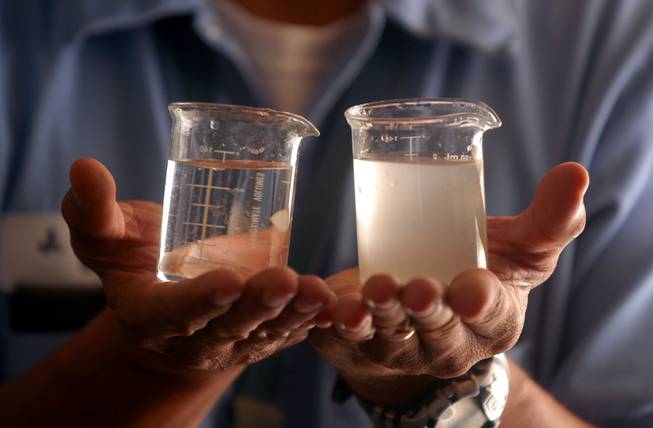
Containers of raw seawater, right, from the Brownsville, Texas, Shrimp Basin and desalinated water are held by Joe del Rio, operator of the Lower Rio Grande Regional Seawater Desalination Project pilot facility. Nevada might trade desalinated water for river water.
Fri, Mar 21, 2008 (2 a.m.)
Sun Archives
- Gibbons takes another whack at pipeline plan (2-21-2008)
- Vegas sees needed water, rural counties see 'fraud’ (2-12-2008)
- Desalination still years away for West (6-29-2006)
- Desalination may be solution to water woes of LV Valley (10-23-2005)
As the West dries up, water managers, politicians and environmental groups alike are searching for an option — any option — to create water.
Recently, desalination has been the popular answer. Even the Southern Nevada Water Authority, which has said the technology is no silver bullet, is considering desalting despite its many challenges.
Last month, Gov. Jim Gibbons made waves when he said he would rather see Las Vegas rely on desalination plants on the Pacific coast than on the controversial planned pipeline to move rural Nevada water to Las Vegas.
Southern Nevada Water Authority General Manager Pat Mulroy has not talked with the governor since he made those comments in Fallon on Feb. 21, but last week she said Gibbons just doesn’t understand how complex it would be to build a desalting plant on the coast of California or Mexico and trade the water it produces for more water from the Colorado River.
“I know that the governor is a rancher himself, and he would probably love to have an alternative for the in-state (pipeline) project,” Mulroy said. “I would love to have an alternative to the in-state project.”
Desalination is sure to be part of the valley’s future water supply, she said, but there are environmental and political challenges to using the technology, which is expensive and uses lots of electricity.
And in the end, Mulroy said, a desalting plant would be useless if drought continues to diminish the Rocky Mountain snowpack that feeds the Colorado River’s flow into Lake Mead, the source of 90 percent of the Las Vegas Valley’s drinking water.
If the lake continues to shrink and shortage guidelines enacted by the seven Colorado River Compact states kick in, Las Vegas would no longer be able to use traded or stored river water.
“When shortages get declared those become impossible to take,” Mulroy said. “All those opportunities either disappear completely or become severely limited in times of shortage. The only thing we can rely on in times of shortage are things that begin in Nevada.”
That’s one reason Mulroy says developing a pipeline or some other native Nevada water source is so important.
“Additional resources we’re trying to develop to protect against a drought would also disappear if we take them as Colorado River water,” she said. “They’re not useful at the time we need that reliability most.”
Another major consideration is the state’s relationship with the six other states, Mulroy said. Because those states were told Nevada was committed to the pipeline project, Las Vegas has been promised the first 75,000 acre-feet of any new Colorado River water augmentation project, such the Drop 2 Reservoir planned for Southern California adjacent to the All-American Canal. An acre-foot of water is enough to supply about two single-family homes for a year. In return, the state must develop an in-state water resource.
“If Nevada were to not develop in-state, its credibility would be so badly tarnished,” Mulroy said. “We (would be) saying, ‘We will not do what all the other states have done.’ It would be viewed very much as a breach of good faith, on Nevada’s part, to rely completely on other states’ resources, particularly during shortage.”
Despite the need to develop water resources that don’t rely on the overstretched Colorado River, the Water Authority is seriously considering desalination in general and an existing desalting plant in Arizona in particular as options, officials said.
Desalination is part of a 2006-07 study of options to augment Colorado River flows commissioned by the seven states. The results of that study are expected to be released within weeks, according to the authority. The study also examined other augmentation options such as cloud seeding and vegetation management.
The study was the first time the authority formally studied desalting, although a spokesman said the option has been discussed informally since 2000.
For now, the authority’s official position on desalting remains that the technology “is not promising as a near- or middle-term option in the face of the drought on the Colorado River ... because it does not reduce our 90 percent reliance on the Colorado River. It has been viewed as more of a longer-term option,” spokesman Scott Huntley said in an e-mail last week.
Mulroy said desalting ocean water could play a role in plans to pump from the eastern Nevada aquifer, the source for the pipeline project. During years when shortage guidelines aren’t in effect, Nevada could rely on desalted water instead of rural ground water to augment its supply.
That would “give us the freedom not to pump in areas of the ground water project if we’re looking to let an area rest for a while,” she said.
The authority in December also began considering use of a plant in Yuma, Ariz., that removes salt from brackish ground water. The plant was built by the Bureau of Reclamation in 1992 to improve the quality of water flowing into Mexico as part of a treaty agreement, but has been mothballed since then because it wasn’t needed.
Although it is too early to determine whether water would be available for Nevada or what the price tag would be, Huntley said that “the initial concept includes an exchange of Colorado River water with Arizona.”
The authority is analyzing the engineering, cost, and environmental and legal barriers to the plan.
The plant could produce 100 million gallons a day, enough water, on average, for about 224,200 single-family households. The plant uses 20 megawatts of electricity when operating at full capacity. It was tested successfully, although not at full power, from March 1 to May 31 last year.
The cost of the plant was equivalent to $250 million today, according to Jim Cherry, Yuma area manager for the Bureau of Reclamation.
During the wetter years when it was being built, the plant was criticized as a waste of money. As the level of water in Lake Mead has changed, so have opinions about the plant.
Cherry said the Yuma plant has served as a technological example for new, successful desalination plants being used around the globe. There are about 13,000 desalting plants operating globally, including 123 in Florida alone, he said.
Advocates agree with Gibbons that it’s time Nevada reconsidered desalination.
“The governor is pursuing 21st-century technology as opposed to the 19th-century pipeline technique,” said Mark Bird, a professor at the College of Southern Nevada and a desalting proponent. He believes a desalination plant in Mexico would be a less expensive option than a pipeline from eastern Nevada.
Mulroy said a Mexican plant is more feasible than one in California, where land prices are high and a strong Coastal Commission has opposed other desalting plants.
Late last year the Coastal Commission approved the $300 million Poseidon Resources desalination plant planned for Carlsbad, Calif., to provide San Diego with drinking water. Environmental groups have rallied against the plant, which has been in the works since before 2000. Opponents complain the plant will be an eyesore and say brine released back into the ocean will kill fish.
Mulroy said it would be even harder to get a plant approved in California if it were intended to ease Nevada’s water crunch.
And no matter the location, cost will be an obstacle.
Desalting is expensive and energy-intensive, according to Peter Gleick, president of the Pacific Institute, an environmental research group based in Oakland, Calif. The institute released a study on desalting in June 2006 that detailed its potential but also the hurdles to widespread use of the technology.
“Conservation and efficiency are cheaper at the moment,” Gleick said. To build a desalination plant and use the water locally costs about $1,000 per acre-foot, he said, or $3.06 for 1,000 gallons.
Take, for example, the desalting plant recently built in Perth, Australia. It cost $357 million. It will desalt more than 26 million gallons of water a day, enough, on average, to serve about 58,300 homes. It also will use 23 megawatts of electricity produced from wind, as much as used by 17,250 average single-family homes.
But the Perth plant — like Yuma’s and the many others like it across the United States and around the rest of the world — also proves that desalination is a feasible option, proponents say.
“This is a country that put a man on the moon, a country with enormous intelligence and financial resources,” said Launce Rake, a pipeline opponent and spokesman for the Progressive Leadership Alliance of Nevada. “We can do this if we have the political will.”

Discussion: 8 comments so far…
Post a comment
- Most Read
- Discussed
- Editors’ Picks
- Wynn ‘relaxing’ interview strategy for Encore
- Jeff Haney has it straight from an authoritative source, oddsmakers, that Notre Dame is to improve the most
- Gibbons: ‘I thought she was having a heart attack’
- GOP abuzz after Heller stirs nest
- Start of school just got pricier
- Local cast likes ‘Mamma Mia’ film
- If they want money to fight foreclosure, it may be scam
- Safety wasn’t in the equation
- UPDATE: Police hunt for 17-year-old in man’s death
- Las Vegas sizzles until Sunday
Blogs
Sports: Upon Further Review
UFC Fight Night: The ol' Peruvian Necktie
Ratner recalls his brief fighting career
NBA Summer League
NBA Day 9: Augmon happy to be back on familiar turf at UNLV
Elsewhere
UFC vs. Affliction
NBA Summer League
NBA Day 8: A tale of two game-winners ... and an almost-was
Cops, Courts and Safety
UPDATE: Police hunt for 17-year-old in man's death
NBA Summer League
NBA Day 8: 'Tractor' out to prove he can still play
Vegas News
Las Vegas sizzles until Sunday (2 Comments)
Calendar
- Coldplay (8 p.m.)
- Trisha Yearwood (8 p.m.)
- NBA Summer League (1 p.m.)
- Michael Grimm (6 p.m. to 9 p.m.)
The Sun
Locally owned and independent for more than 50 years.


People used to say California was a state full of nuts. That designation has now passed from California to Nevada.
If Governor Gibbons and Launce Rake think that it is in any way possible to build a desalinization plant in California, for the benefit of Nevada, they are simply nuts.
The environmental community is California is profoundly strong and growing. Those who specialize in protecting the Pacific Ocean are the most powerful. There is no way on God's green earth that California's environmentalist community will permit desalinization plants to be built in Orange, Los Angeles or Ventura County. They have completely prevented the drilling of offshore oil platforms on the ocean west of LA County, and west of Orange County's Gold Coast.
Anytime desalinization is mentioned to California Sierra Club, Bay Keepers, Heal the Bay, NRDC or Center for Biological Diversity officials, they laugh derisively at the naivete of the person even contemplating desalinization.
Why? Because there are already desalinization plants around the globe, whose effects on marine biology have already been studied. The means by which the desalinization plants are operated causes large "dead zones" in the surrounding life, where no marine mammals, fish or plants survive.
Southern Nevada needs real water solutions. There are only two: Prohibition of construction of new casinos and new homes in Clark County, or build the pipelines to east central Nevada.
The water shortage crisis created by combination of drought and growth is not a joke. The same problem exists in the Atlanta area, where their water supply is 90% gone.
Nut jobs like Governor Gibbons, Launce Rake and other opponents of the pipeline, talking about desalinization plants in California, are not doing anyone any good, and instead only delay solutions to the water problems in Southern Nevada.
A QUESTION for Nevada ....
A new fresh water Source solution exists for Nevada that will yield ONE MILLION acre feet a year. Development of the Source has been GUARANTEED not to damage the environment or the water rights of anyone, anywhere. Development of the Source will not interfere with the Southern Nevada Water Authority plans for new pipelines. Secondary uses include keeping Lake Mead reasonably FULL, hydro electric generation and restoration of the Colorado River Delta. Delivery of water from the new Source is not affected by Ms. Quagga mussel !
A full disclosure of the Source has been offered on a confidential basis to the Bureau of Reclamation and the Southern Nevada Water Authority for five (5) years.
The QUESTION is this....if disclosure of such a vast natural resource can be made to the SNWA and the Bureau for FREE, should the SNWA and the Bureau formulate a way for disclosure to occur ?
An offer has been made that an attorney of the SNWA & Bureau's choice be selected to review and report back as to whether the Source warrants a full investigation. It is claimed that the Source is economically feasible and legally available to develop.
Does this seem like a reasonable procedure for the Bureau & the SNWA to seriously consider ?
What do the citizens of Nevada think ?
WaterSource Ray Walker (Retired Water Rights Analyst) waterrdw@yahoo.com
It amazes me how many people in California don't even know where they get their water from. They water the sidewalks when it's raining and act like it flows endlessly from the ocean. And there is no end in sight to the sprawl they keep building.
Which is more sustainable, the city that gets it's water from 20 miles away, or the city that gets it from 200 miles away? Well in this case it's the later because they got to it first.
California will have to build desal plants to sustain future growth. If we ever manage to reduce California's dependence on the Colorado River, the river will provide Las Vegas with all the water it needs.
Dr. Truth says: "California will have to build desal plants to sustain future growth. If we ever manage to reduce California's dependence on the Colorado River, the river will provide Las Vegas with all the water it needs."
Dr. Truth is just another person with no factual knowledge of what is going on in California water law and politics. Californians do not want their state's population to grow, and their legislature, cities and counties are taking all sorts of steps to prevent development of new water sources. Under Federal law, all of the farms and water districts in California have a vested ownership right in the water from the Colorado River. There's no way they are going to give it up without astronomically high cash payments. Plus, they can't give it up without approval of California's Governor and Legislature. That isn't going to happen because the political view of Northern Californians is that any taking of water out of California creates threat that their water (as opposed to that of Southern California) will be taken. And, oh by the way, in Jerry Brown's era the California Constitution was amended to prevent diversion of water from Northern California rivers.
Think about the reality: Nut job environmentalists in Nevada want the environmentalist politicians in California to lighten up, and give Nevada more water.
Fat chance!
Humans are constantly trying to engineer their way to a better world. Remember the "Better Living Through Chemistry" slogan? That led to the chemical pollution of every living thing and every square inch of the planet.
Now we're being told "Better Living Through Pipelines" or "Better Living Through Desalinization." Either way, it's a very energy-intensive dead end.
Regarding water, it is time to recognize that there are limits. We have exceeded many of them in Nevada, especially in the south. Population is the real problem but is rarely discussed. How about electing a rational administration in DC that will aggressively promote responsible family planning on a global scale?
We must strive for zero or even negative growth if we wish to sustain our community (local and global) over the long haul. Otherwise, we'll engineer ourselves into an even tighter corner a decade or two down the road.
Real economic principles must be in alignment with the natural world. If not, they will only create short-term benefits for a few and eventual disaster for all. The pipeline leads to it. Desalinization does too. Exporting our negative environmental impacts is not a solution.
We live in a very dry climate. Are we so immature that we can't face that fact? We waste millions of tons of water. Who said Nevada should look like Florida or Illinois? Amazingly, we still allow grass! Stop it!
Stop the growth. To do otherwise is a form of collective insanity that will lead to even greater problems in the future.
Embrace the Mojave and stop trying to remake it into something else. It's a beautiful desert. Let us not fool ourselves that this fragile, arid environment can sustain additional millions of people - residents or visitors.
What happens when you put too many people into one boat?
Water is quickly becoming a national problem. Rather than have Pat Mulroy build a pipeline to Ely, the west as a region needs to think about where it can get water from in dry years, and, in turn, send water to in wet years.
It's looking like 2008 would be a banner year to pump water back from the Missouri basin. Expensive? Yes. A better option than desal / sucking the water out of Snake and Spring valleys? Probably.
Going to happen before a Western president is elected?
Doubtful.
Several news articles on seawater desalination reveal
that desalination technology is little understood by
most journalists, local water managers, politicians
and environmental groups. In searching for
renewable potable water or supplementing current
sources few are aware that there is more than one
desalination technology.
When evaluating a desalination project Reverse Osmosis
is typically the process considered. Yet, there is a
viable and proven alternative in distillation. The
Advanced Vapor Compression Desalination
Process is an advanced and highly environmentally
friendly desalination process, an alternative, single
performance, and lower maintenance process compared to
Reverse Osmosis. The system is based on proven
flash distilling principles but features an innovative,
highly efficient, and compact design. Additionally,
it offers a unique advantage in the treatment of salt byproducts.
The system produces outputs of either valuable crystalline
Salt or concentrated brine. The process is optimized for
the desalination of seawater drawn from wells below the
sea floor and not returning the brine to the sea.
The process has modular abilities and can be expanded
to meet future requirements in water demand or
designed and built at the start for higher volume. A
basic plant design can operate on solar, thermal,
nuclear or traditional energy sources. Each unit is
optimized from an initial engineering site study to
account for different environmental and structural
needs. A basic stand-alone unit of 1 acre-foot per day
has a footprint of approximately thirty feet in
diameter. The larger the plant water volume the lower
the cost is per acre-foot. The plant energy
consumption is on the order of about 5 to 21 kw per
1000 gallons produced based on the design, volume
produced and type of energy.
The system can also be used in industrial treatment
and recovery of effluent water. The life cycle of the
plant is based on a 25 year time line which can be
extended through proper preventable maintenance and overhaul.
Cynicalobserver raises some excellent points about prudent water management steps that are needed BEFORE desalination is contemplated. However, he/she is quite wrong about "dead zones" and impacts to the marine environment. There are 691 seawater reverse osmosis plants operating around the world which produce 0.5 billion gallons of drinking water daily. They are located as follows:
Asia = 118
Europe= 145
MENAGTZ = 214 (Middle East, North Africa, Persian Gulf)
North America = 31
Rest of world = 183
I challenge CynicalObserver to name one, just one, with a documented dead zone or other documented examples of marine destruction. You can't do it because this is a myth.