Las Vegas Sun

August 28, 2008

SUNDAY CONVERSATION:

Signs are dim, but is Vegas’ future?

Experts admit we’re in a deep downturn, but each envisions a rebound — eventually

Image

Sam Morris

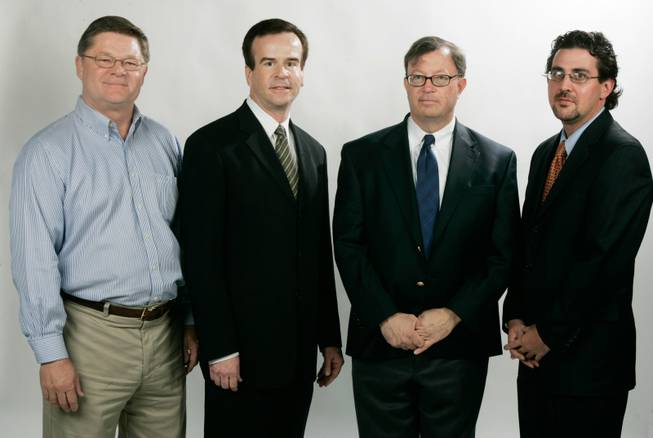
From left are Dennis Smith, Dale Gibbons, Jeff Hardcastle and Jeremy Aguero. Gibbons is chief financial officer for Western Alliance Bancorporation, parent company of Bank of Nevada. Smith is president of Homebuilders Research Inc. and a member of the Southern Nevada Homebuilders Association. Hardcastle is the state demographer and Aguero is a principal analyst with Applied Analysis, a financial advisory and economic consulting company.

Sun, Aug 3, 2008 (2 a.m.)

Economic Roundtable

You need to upgrade your Flash Player

Reader poll

When will the Las Vegas economy start to show signs of improvement?

View results

For those of us who thought we lived in Boomtown U.S.A., the dramatic downshift in the economy has been unsettling at the least, jarring for many.

On Friday, Boyd Gaming paused work on Echelon — eight floors above the ground — until it can figure out how to pay for its $4.8 billion hotel-gaming complex on the Strip. Just that fast, 800 construction workers were sent scrambling for other jobs.

MGM Mirage has run into delays in financing a remaining piece of its $9.2 billion CityCenter project.

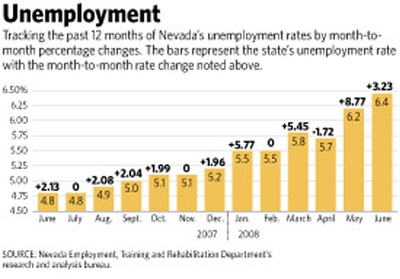
The jobless rate in Nevada climbed to 6.4 percent in June, the highest rate in more than 14 years.

Airlines are questioning the need for a third terminal at McCarran International Airport, unsure whether they can sell enough seats as fares go up and flights are cut back.

Tourist spending is down. Nevada’s gaming revenue is down 15 percent, the worst in more than a decade.

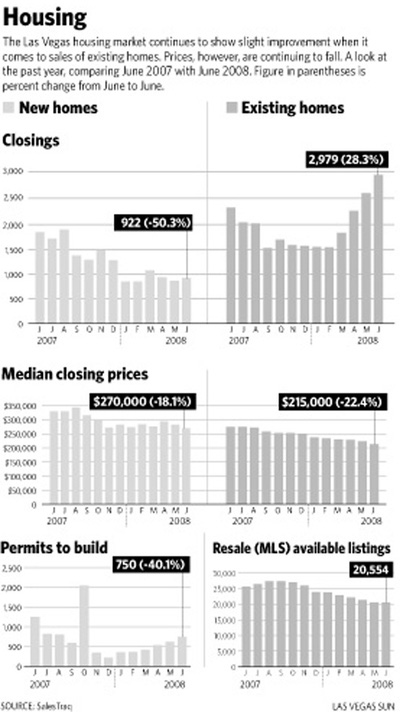
New-home construction remains stalled, and the median price of a home is about $270,000, down from $329,000 two years ago.

Nevada leads the country in the rate of home foreclosures.

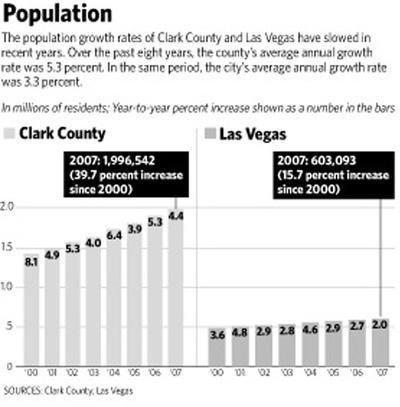
We’re no longer holding the pace of 5,000 new residents a month. The school district is reexamining how many schools to build.

Bottom line: We’re in the midst of the worst economic downturn in several decades.

Las Vegas will recover, but it won’t be as soon as we’d like.

That’s the consensus of four economic and home construction experts gathered by the Sun to discuss challenges facing Southern Nevada — what’s gone wrong and where we’re headed.

The participants for our Sunday conversation:

• Jeff Hardcastle, the Nevada state demographer.

• Jeremy Aguero, a principal analyst with Applied Analysis, a financial advisory and economic consulting company.

• Dale Gibbons, chief financial officer for Western Alliance Bancorporation, parent company of Bank of Nevada.

• Dennis Smith, president of Homebuilders Research Inc. and a member of the Southern Nevada Homebuilders Association.

The discussion was held Wednesday ­— before Boyd’s decision to pause construction on Echelon for up to a year, which will only exacerbates the economic challenges faced by Southern Nevada.

The remarks by our roundtable participants have been edited for space and clarity.

Jeremy Aguero, with Applied Analysis: The economy is the worst it’s been in 30 years. It’s reminiscent of the economy of the early 1980s.

The question is whether this is part of a cycle, or have we hit some mythical tipping point? If you look over the history of Southern Nevada, it’s pretty clear that we run in very well defined cycles. We have for the past 30 years. The cycles are dictated mostly on the opening of major hotels and casinos.

Although we have diversified, we are among the narrowest economies in the United States. One in every 10 jobs created (has) been in the hotel-casino industry, and 50 percent of our employees are dependent on two industries: tourism — including hotels and casinos — and construction.

Both of those are cycling down concurrently, and that’s creating a unique circumstance.

Dale Gibbons, chief financial officer for Western Alliance Bancorporation: Clearly there was a situation where we were riding quite high. If you look at any five-year period, going back three decades, Nevada has been the fastest growing state in the country.

Now we’re No. 1 in the foreclosure rate, and we’ve recently shown the steepest declines in home values. So I concur that things are on the downside. But we still have population growth in excess of 3 percent, which is extraordinary compared with the national average.

Jeff Hardcastle, state demographer: The fact that we have a monopolistic industry, gaming, plus housing, available water and easily developed land, especially in contrast to California, is important.

Job diversification is also important because it helps cushion the loss of residential construction jobs. We’ve seen 15,000-plus jobs lost in the Las Vegas economy in the last few years, primarily in the construction sector.

Aguero: We’ve lost 10,000 jobs in the private sector. That means we’re going to have less in-migration. It happened during the early 1970s, the early 1980s, the 1990s, and during the time leading up to Sept. 11.

The reality is, fewer people are moving into Southern Nevada today and more people are moving out of Southern Nevada. And the reality is, we have a less robust economy.

We’re developing office space, industrial space and retail space for the next 100,000 people moving here. But if those 100,000 people don’t come, we’ll see rising vacancy rates, like the office market that’s currently almost 17 percent vacant.

Dennis Smith, president of Homebuilders Research: The homebuilding industry is in hibernation. Homebuilders have not given up on Las Vegas. They’re just adjusting to the current situation. The housing cycle is nothing new.

But this situation may be unique because first we had a housing oversupply, and then we had credit problems.

The Las Vegas situation seems much worse than it likely is. Because if you look at some of these other so-called hot markets around the country, you’ll find that most of these other markets are in much worse shape than we’re in, in terms of supply.

We’ve got people who are moving away from Las Vegas for strictly economic reasons. They’ve lost the wealth they believed they had in their houses.

Things will change here, but it’s going to be a longer fix than most people in Southern Nevada are accustomed to. I see an extended recovery period.

Gibbons: We’re being affected because we’re a high-growth market but now fewer people are moving here.

Aguero: We got to an inventory of 30,000 unsold new homes when we should have had only 13,000. The worst case scenario would have been if we had gone up to 50,000 to 60,000 available homes.

If homebuilders had continued along with that production pattern, and it ended up there wasn’t enough demand for those excess houses, we would have had a much worse problem than we now have.

Smith: I think the new home segment has pretty much bottomed out, and it will stay flat for months to come. And the resale segment is softening somewhat, and will continue to soften. As a result, prices will lower in that segment.

Frankly, the prices for new homes are as low as they’re going to get. Builders can’t build them and sell them for any less. It’s that simple.

The supply of new, unsold homes in Vegas is low — less than 1,000 units. You can’t say that about resale. The resale segment is going to continue to grow because of the credit situation we have today.

I don’t think the housing turnaround that Las Vegans are accustomed to seeing is as close as most would hope.

Aguero: But we have something in our hip pocket. Unlike other markets in the United States, we have $36 billion worth of construction going on in our core industry, gaming.

Encore is going to open up here by the end of the year — that’s 5,300 jobs. CityCenter is worth another 15,000 jobs. You have Fontainebleau — another 8,000 jobs, plus or minus, coming down the pipeline.

I’m not here to suggest that every one of those jobs will necessarily materialize. But I don’t think you can point to many other markets with that level of investment in their core industry.

Hardcastle: You do have projects for job creation that will be coming on line. But I think there are a few things that could throw a big monkey wrench into the whole thing.

To fill those jobs, you need to see some serious in-migration in the next year or two, or have unemployed people move into those jobs. And we have a fairly high unemployment rate right now, so some of those people may be absorbed.

So you’ve got this potential drag on getting workers in, plus you’ve got an uncertainty with fuel prices and airline prices, which is discouraging travel.

The big question is, what comes after the big projects underway are concluded? What happens to those people with construction and other building-trade jobs?

Gibbons: I think the amount of projects going on the Strip is a huge pull. And that pull will be met. These are going to be relatively well-paying jobs. I don’t expect our unemployment rate to rise more than what we’re facing today.

Granted, we will see a reduction in construction jobs at that point. But once these projects come on line, I’m pretty sanguine about the future.

Aguero: And as bad as it is right now, you’ve got to be encouraged about the number of applications that (Steve) Wynn’s already receiving on his Encore project.

I think we should look at the lulls that we had before the opening of the Mirage in 1989, before the opening of MGM Grand in the mid-1990s, and before the Bellagio and Venetian opened.

You can compare what’s happening now to the lulls in any of those periods, though they may not have been as deep.

Gibbons: At the same time, I think you’re going to see some pent-up demand in terms of housing. And I think the rental market will end up being stronger.

Aguero: There is no community that has added as many employees to the market in the past decade, or that has added as much population per capita in the past decade. Likewise, there is no community that built the number of houses per capita in the past decade.

There is no community in the United States that added more personal income from the past decade. That’s where we are today.

We’ve got an attractive tax structure, and we’re still marketable to retirees. I don’t think there’s another market with the same level of per capita in-migration of retirees.

These fundamentals all still apply. Nationally, it’s still gloomy, and people are taking fewer vacations than has been the case in a long time.

But if the perception is that we’re at this tipping point, that we’re no longer a great place to live, or to come and visit — I think it would be wrong to draw that conclusion.

Smith: As far as bottoming out, I think we are seeing that as far as the housing market.

One realtor said that while foreclosures are happening, the type of properties that are for sale are “good properties,” and have had multiple offers.

I’ve heard about lots of situations where properties are being sold for more than list price. I spoke to a person yesterday who said he made an offer at list price but lost out to a person who offered $30,000 over that price.

So while we have properties that are selling for list price, it appears we are starting to establish a higher price level for those properties.

If you want to gamble on prices still dropping, go ahead. But today I know that the prices are as low as they’re going to get in most instances. And I also know that the interest rates are going up.

I would rather take a lower interest rate and get a low price that I know is a good price today, than wait to see if it might go still lower. It could go lower because some of the foreclosures in the resale situation, I agree. But I would suggest that now is as good a time as any. I can’t say it’s going to get better.

The market will take care of it. Let the business cycle go. It will take care of it itself.

Aguero: I sort of have a free market attitude like Dennis. We have the ability to see that we’re in a cycle and bring the fire trucks up to the front, understanding that the other side is worse.

If you’re sitting in the shoes of the state Legislature or the government at large, I think the reality is that cycles run. I think the government needs to recognize two things: One, that revenues increase very rapidly, and two, they decrease very rapidly.

If we can recognize that, I think we can be better prepared the next time it happens, because it will happen again.

Smith: Hopefully someone, somewhere can learn from history. Have we learned enough? Probably not.

Aguero: Is Las Vegas recession-proof? That was the question everybody asked for a long time. And the answer to that is “no.” That’s never been true.

If you look at our history, we’ve been resilient and resourceful through a handful of recessions. And I think locals would argue that we’ve come out stronger each time – something that’s unique to Las Vegas.

Southern Nevada’s narrow economy, dependent on two industries, tourism and construction, was uniquely positioned to be hit hard.

So, we ride it out by relying on what made us the most successful economy in the United States in the past 20 years. We build on these fundamentals and we try to take steps to mitigate the pain of the downturn while we can.

The market is fixing itself. It will take time, but it will fix itself.

Population shifts are another thing. Twenty four months ago, Dennis and I were in front of a committee on housing, and they were berating us for a lack of affordable housing.

But the answer is not going to be affordable housing. It’s going to be housing prices if we can’t sustain growth. What will that mean in terms of a loss of equity?

Hardcastle: There are questions regarding wages, not just housing prices. National Public Radio had a story recently saying that Las Vegas was the mortgage default capital of the country.

The problem is not just pricing got driven up by speculation — but also wages.

For casino workers looking to make a good wage, to get into a Mirage or a Bellagio, say, you have to work your way up.

The El Cortez, the type of place where lots of casino workers start out, doesn’t pay as much as the Mirage. So we’ve got an imbalance of income.

Aguero: But you are going to get paid more in the construction and tourism industry in Las Vegas than almost anywhere else in the United States. And the cost of living is substantially higher in other places, too.

Hardcastle: There are people moving here who think they can easily make a great wage, but in reality there’s a wide range of incomes here.

We hope people continue to move here. If you don’t have workers who are trained or the capacity to train them, we’re going to have to import those workers and have the facilities to train them.

Aguero: I’m bullish on Las Vegas. I don’t have a crystal ball, but if history is any kind of a guide, I like our chances in the next five years.

Smith: The optimism in Las Vegas is not as shiny as it was, but it’s still there.

We know there are “X” number of casino hotel rooms to be completed. I don’t know if 2011 is the date. It could be 2015, or 2018. It depends on the financial markets.

When money starts to flow again, when that situation starts to improve, we’ll have a clearer picture of how long it’s going to take.

I think we need to realize in Las Vegas that we have a limited supply of land. So as long as you have finite resources, is it safe to say that sometime in the future there will be a run-up in prices again? Yeah, sure it can happen again, assuming those dynamics of limited supply are still there.

I think it’s unrealistic not to be somewhat bullish on the long-term growth of Las Vegas. Now, short term, sure there are going to be some spots in the road. But we’ll get through this.

Hardcastle: I’m not saying that I’m not bullish. But look out beyond the Las Vegas Valley.

Look nationally. Because the question is: Is the hotel-casino business structure sound? Regarding the airlines, the industry has been underpricing tickets for some time and that has finally been catching up with them.

Thirty percent of our visitor volume on a good day comes from California. And some of that comes from flying, not just driving. But the other 60 or 70 percent are from Colorado, Utah or Arizona — and a large chunk of those people are flying in.

And there are other challenges.

More people went to gamble in Macau for the New Year than Las Vegas. That’s the first time that ever happened. We’re now having to compete harder for international tourists.

Aguero: That’s not new. Macau is certainly a new and different location. But we were warned in the early 1970s that all the high rollers would go to Atlantic City.

We heard in the mid-90s that gross casino revenue from California tribal gaming had exceeded that of Las Vegas.

But the reality of it is, in regard to tourism, it seems to me that it is always a growing pie. We may be getting a slightly smaller piece, but we’re getting a piece of a slightly larger pie.

In regard to Macau, the vast majority of people traveling there never had the opportunity to come to Las Vegas.

Having brands like Wynn and MGM throughout the United States will make those brands stronger. One question we have to ask as these markets develop is, should these companies, with gas prices being what they are, invest more in various satellite facilities rather than strictly in Las Vegas? I think that’s a fair question.

The Sun: In investment terms, is Las Vegas a safe investment, a somewhat risky one, or is Las Vegas volatile?

Smith: I think if you’re going to invest long term, Las Vegas is a pretty safe bet. I think the volatility is always going to be there, but I think it will be lessened because of the growth of the area.

Aguero: I agree that gaming stocks are undervalued. I believe that investment is the right one.

Smith: To me, the number one issue is the lack of financing that is curtailing construction.

Gibbons: I’d call it economic malaise. Gaming revenues are down 16 percent, McCarran is down 5 percent.

At the end of the day, it comes back to the notion that we are in a slump.

And I think we’re going to get out of it, but again, there’s not a lot that can be done.

Aguero: I think the biggest issue for Southern Nevada is making sure not to turn our community into a cash cow.

It’s as though we think that we no longer have any responsibility to invest in our long-term health as a community. If we can’t learn to invest in things like transportation or public education, I think we’ll have real problems.

The reality is that we’ve created an economy that basically relies on two industries, construction and tourism. Diversification is necessary. Tourism will always be part of our future, but it can’t be the only part.

Sun reporter Mary Manning transcribed this conversation.

Discussion: 29 comments so far…

  1. Not one word on high gas prices.

    They say this "Tourist spending is down. Nevada’s gaming revenue is down 15 percent, the worst in more than a decade."

    A previous Sun story talked about a survey that demostrated that high gas prices were a significant reason for the tourist numbers going down.

    Nothing here about why tourist spending is down.

    According to these experts, I guess Vegas will be OK if next summer the prices go higher because none of these experts think gas prices is a problem.

    Hmmmmm....seems odd...but they are the experts????

    Something smells fishy here...........

  2. Actually they mentioned travel issues and one of them actually said "uncertainty in fuel prices". But I agree with your premise that high fuel/energy prices are the driver. I would say that there is no uncertainty - they will go higher! Therefore, LV and NV will continue to have problems for the foreseeable future. LV has experienced high growth due to low fuel/energy prices which translates into low food prices. World wide Oil supply has been stagnant for the past 3 years and will remain that way and eventually drop!

  3. Like most of Las Vegas, these wise city fathers are in denial that the lack of water will emerge as a constraint to growth. Even if you pumped every single drop from White Pine and Lincoln County that SINWA demands, Las Vegas would still be in a deficit according to current usage and demand forecasts. It's time to wise up.

  4. Thanks to Reid-o-nomics, the cash that used to flow into Las Vegas is now flowing into gas tanks. If the people of Las Vegas are as clueless to the cause of their problem as the four morons in the above story, then Vegas deserves to return to desert from which it came...

  5. Perhaps someone should mention that Senator Harry Reid has been short on help by refusing to listen to the people of this country - 75% who want domestic oil drilling. Not only would this bring the price of gas down (sooner than later), more domestic jobs, we would be sending less money sent to the countries who hate us and want to kill us. Developing alternative energies sound like a great idea, but that is not something that will help in the short term. As a state that is dependent on tourism, I would think you would put the pressure on him to get in there and allow a vote on domestic drilling. I don't understand why these politicians do not listen to the people. Why don't we as Americans demand that we be allowed to use our own natural resources?

  6. It could be that Searchlight Harry Reid in his pugilistic days took far to many punches to the head that made him senseless and hard of hearing due to cauliflower ears. As for the 4 experts-------an expert is one that wears a suit, carries a brief case and travels over 50 miles. Bottom line there are no experts in this world. Searchlight Harry has a single digit approval rating for his leadership in congress.

  7. Nothing at all about how the industry has gone upscale and shut out many middle-class and blue-collar visitors. The investment went into the high-roller type properties, one supposes with the idea that this market segment is the most "recession proof." One supposes that's been proven wrong, too.

    While this story is interesting, it reveals almost nothing. Too much is missing, from either the wrong questions, the wrong experts, or an unwillingness to be truthful.

    Just how bad is it?

  8. Here's my take ---

    1) Tourists are sick of being fleeced on overpriced rooms, expensive (and tasteless) meals, show tickets, clubs, etc. OK, Harry Reid gets free tickets and comps, but the rest of us have to pay through the nose. Bad service at many places in Vegas due to poor hiring practices doesn't help either.
    2) Now the airlines are starting to raise their prices on airfares, baggage, and everything else while at the same time lowering their capacity into McCarren.
    3) As for housing, the cost per square foot across the valley is still outrageous and at times hilarious for those who bought condos on or near the strip.
    4) Top it off with the price of gas and you lose out on all the CA weekend visitors.

    Too much finger-pointing with no action. I see a long downturn for Vegas.

  9. Beefski...thanks for pointing out those quotes.

    It was almost a hidden message.

    Many airlines, like US Airways, have reduced flights to Las Vegas by nearly 20% because of new higher fares that deal with the cost of high fuel cost. They know that many people will not be able to afford the new fares.

    Gas prices will go down until Jan/Feb. They do every year because summer travel is over and demand will drop. It goes up during the winter because people heat their homes with oil. It go down again in late winter/early spring.

    Next summer gas prices will again be at $4.50 or probably higher.

    The system is not bringing enough supply capacity to deal with increases in demand from China/India.

    The supply capacity is marginally above peak summer demand. That is why gas prices are so high. They are worry about supply events, like war, storms, etc and triggering a supply less than demand situation.

    That is why contracts promising future delievery of oil are so valuable.

    Until we restore a reasonable level of capacity above peak demand these anxiety market will continue.

  10. Obama read the polls and now restated his previous position that drilling is ok as long as its part of a total energy plan. I think there were some Republicans debating this without democrats and lights and microphones while Pelosi and Reid were on free jets home for the summer. Obama just sold out Reid and the Democrats in the Senate will probably replace him when they return. Las Vegas can't get visitors here with free flights. Their money already went into slot machines with no payouts back home, they are called gas pumps. It's our fault Harry Reid is holding back, not enough of us have yelled at him

    Email Reid of Phone his office
    http://reid.senate.gov/contact/index.cfm...

    Las Vegas
    Lloyd D. George Building
    333 Las Vegas Boulevard South, Suite 8016
    Las Vegas, NV 89101
    Phone: 702-388-5020 / Fax: 702-388-5030

  11. I am Canadian and Las Vegas used to be a great place for a short vacation and did not cost a fortune. It was a place the average person could have a good time and not spend a whole lot of money... well if you were disciplined enough regarding the gambling ....

    when the new hotels went up suddenly the rates shot through the roof for hotel rooms,flights and the decent priced buffets and special offers went out the window

    It became a place for yuppies and those with the big bucks.

    Now there is a downturn.... and maybe regret?? that you dumped your faithful ordinary folk that were the backbone of your business ??

  12. Smith couldn't resist getting in the "never been a better time to buy" line. The reality is that Las Vegas has seen strong growth for so many years that many believe that it a fundamental law of nature that said growth will continue in a continual arc upwards.

    Given the new levels of energy pricing, the scarcity of future water supplies, the impending nationwide recession and increased competition from upscale casinos overseas, it is no wonder that Las Vegas growth has finally hit a brick wall. I seriously question whether Las Vegas will EVER experience the heady explosion in the local economy that it has in years past. And the old "limited supply of land" argument has been so discredited that I am surprised that it is even proffered anymore. The BLM has lots of land for sale, unfortunately no one presently is willing to pay for it.

    Given all the above, I must say that the so called "experts" are alot more realistic than they were a couple of years ago. Who can forget Steven Bottfield blowing soap bubbles at his audience and mocking the Las Vegas bubble?

  13. I disagree.

    If the gas problem can be solved than tourist will return in droves to Las Vegas.

    Once that occurs then the resort/casino building boom will return.

    There is limited land in Las Vegas because all the other land is own by the Feds.

    At some point in time, land prices will skyrocket again.

  14. Btlover, you hit the nail on the head.

    Driving on the 95 last night, I passed a billboard for Santa Fe Station, a locals casino. It's not the newest or the brightest casino but it's not awful.

    The billboard was for an ultralounge inside the Santa Fe. It was promoting bottle service, for heaven's sake!

    Bottle service is when you purchase an entire bottle of some insanely overpriced alcohol so that you will have somewhere to sit in the club you just paid $20 to get into. Bottle service typically starts above $400.

    Now, if this were at Caesars or Palazzo or Wynn, I wouldn't have batted an eye, but it wasn't. It was at a locals casino fifteen miles from the strip... whose neighbors include an adult video store.

    Vegas is too expensive for their average visitor. At one time, people would spend $100 on room and meals and now, they spend $700 on the room and food.

    Fuel prices wouldn't be an issue if Vegas tried to bring down some of the insane prices on the Strip. People would be willing to spend the one tank of gas to get here from SoCal if rooms were $50.

    And it would be wise if the Visitor's Authority doubled or tripled their international advertising. The weak dollar and favorable exchange rates for many European and Asian visitors would be a boon to the city.

  15. All of those are good ideas.

    I would add that they should be doing more about getting casino theme buses running out of California.

    When I lived in Philly we would take the casino buses to Atlantic City all the time.

    Most of the airlines have cut back on flights to Las Vegas. The casinos have to figure that out, too.

    There is only so much they can do. They can not operate at a loss just to attract tourists.

  16. Some of the commentators here don't get it either. The "gas price problem" cannot be "solved". Energy costs may fluctuate, but the long term trend is upward. It is simply going to cost more to travel. The BLM IS the federal government and they can't even sell their land at auction in the current environment. More land is always available via swap agreements as has historically been the case. Land prices may skyrocket, but only if the dollar is devalued by an even greater amount.

    Even if things turn around tomorrow, Las Vegas will most probably NEVER experience the peak rate of growth it has in the past. It is like talking to an addict. Unless they acknowledge there is a problem, there is no hope of ever fixing it. Las Vegas must plan for sustained slower growth or have the slower growth forced upon it with negative consequences. Just ask Boyd Gaming (Echelon). Or Deutsche Bank (unfortunate owners of the Cosmopolitan).

  17. What is driving up gas prices is that supply capacity is marginally above peak summer demand.

    Any event can push supply below deman.

    That is why contracts for future promises of oil very valuable.

    Once the margin of supply capacity is restore to a safe margin above demand then prices will fall significantly.

    It probably will be a year or two before that occurs. Either a recession in China/India will reduce demand or enough supply will be added.

  18. Las Vegas needs to become its own state so we here in the north can grow up and create our own. It's obvious that in 'Vegas more is better, more low wage jobs, more expensive traffic congestion, more smog, more crowded schools, more water grabs, more crime, more crowded jails...but if you live on the cloud above your competition, your view is sunny and bright. Northern Nevada needs to get off the dime from 'Vegas and get on the dollars of a bright green energy future with solar, wind and geothermal. Export that energy with a fat franchise fee on it. Like oil for Alaskans.

  19. When any business has high growth and profitability for a long period, it is normal for them to overstaff and be inefficient. Now that things are bumping along and the growth is not there, managers will now look to make their operations more efficient. Translation: Have a nice day, here's your pink slip. Sands and Southpoint have already announced their intentions to permanently reduce staff. Are they the oddballs or are they the first of many to do this? If they are the first of many, how many net jobs will there actually be when those other projects come online?

  20. Drilling for oil NOW won't solve the problem NOW. It might lower prices a few cents for now, but that doesn't ameliorate the environmental effects and diminish our own stupid refusal to support more diverse energy research. Why we don't rely more heavily on solar and wind power, especially in this state, is beyond me--unless it's the policies pursued by the regressive and retrograde who appear to enjoy the support of the Harry Reid-haters who have come over from the R-J to spew here rather than trying to propose realistic solutions.

  21. Energy will work itself out, the dependence on oil is running it's course. When we first started traveling in the 1920's oil wasnt' the bas energy, and being in the free enterprise system we are in it will work itself out again. This isn't an overnight fix, but it will happen, there is just too much profit to be made in doing so.

    You can get a room in Vegas right now for less than $30 a day if you aren't a yuppie' and don't have to stay at a AAAAA resort, price is all about supply and demand. Casinos arent going to charge what they can get. If there isn't the demand for a high priced product, prices will come down or the place will close. Look at Ice as a prime target or any of the other many night clubs which have shuttered.

    Las Vegas is an attractive product now and will be, there are just too many smart and wealthy people who have their fortunes depending on this place not to do whatever it takes to make it work. Occupancy is still over 90%, the downturn is the $$ spent per person who visits here, especially in retail and other non-gaming activites.

    The housing market got overbuilt, that will correct itself with time. The real losers in almost every case are the people who get in at the end (2005-2007 here); the same happend with the pyramid schemes in the 80's, the .com era in the 90's and the housing markets in the 2000's. In 2 years we will be laughing that we ever worried about this

  22. jfnance32... I usually agree with what you say, but you need to get past gas prices being the root of all evil. It's a factor, but probably not even the largest one.

    I've been waiting and hoping for someone who doesn't live here to chime in, and thanks to btlover1, we finally have someone give their unbiased input. And guess what?! They didn't even mention gas prices. But what they did mention was what I believe to be an even bigger, tougher issue to fix. It's not the cost of getting here that's the problem, it's the cost of BEING HERE! The experts, and most of the posters here who insist on making this a political issue, are completely missing the point: People can still get here. Fewer people WANT to. The expense of staying in Vegas has far outpaced the rise in gas prices or most other cost of living items. Not to mention that because of the way things are financed nowadays and the boards of all these large corporate resorts needing to maximize shareholder value, the general experience of being here has been cheapened to the point of being nothing special. Everyone on the strip (and now the locals places too) have taken large steps to extract as much money possible from the vistors that come here, and have started giving less and less back in return. It's only a matter of time before people make other choices than Vegas.

    I can't conclude this without taking the experts in the article to task for something though. It sounds like they're drinking the same kool-aid that alot of residents here are. As long as you look at the problem as a matter of "when" and not a matter of "if", nothing will get done and the problem festers. When people really start to look at Las Vegas from an objective point of view and realize that it might not make it, then things will get better. Go back to making it a special experience for the average vacationer, and they'll come here despite $4 a gallon gas. Taking things for granted and ASSUMING it's a cyclical issue has ruined many a good thing.

  23. Well. we all know the adage about a house of "CARDS." When said house's foundation rests upon the shifting sands of a fickle public's discretionary spending, it can all the more easily come crashing down.

    This month we were hit with a 42% increase on electric bill for "Purchased Power Adjustment" due to higher fuel costs for power generation. Every time we go to the grocery store, food prices are always higher than previous visit, gasoline is in a never ending spiral upwards, with downtick pittances only temporary.

    Wife and I are old and on a fixed income, food and the AC come first for us here in AZ with temps up to 120 degrees, and they are not discretionary, they are necessities.

    Obama and the democrat's energy policy is:

    1) No to new drilling offshore or in ANWAR

    2) No to nuclear

    3) No to new refineries

    4) No to new pipelines

    5) No to oil shale development

    6) NO TO FOSSIL FUELS OF ANY KIND (except what they can cajole or threaten out of OPEC)

    7) Yes to using up our grain food stocks for polluting bio fuel plants.

    http://www.google.com/search?hl=en&s...

    Obama tell us to buy a small car, overinflate the tires, tune it up, get a wind surfboard sail and wait on the wind for ambulation.

    http://i16.photobucket.com/albums/b27/Jo...

  24. All of the gas price talk tells that the common man doesn't get it. Gas prices haven't gone up that much relative to their overall price. People have a psycological problem with seeing over $4/gallon on gas. Has anyone on here been to another country lately? They pay this much per liter! We are a spoiled country that doesn't get it. I would like to know what percentage of Americans live within their means these days. It is a concern since our national debt is crazy right now.

  25. What Vegas seems to have lost is the fact that the hotels & food used to be loss leaders to get people into the Casino to gamble. I'd rather gamble at my local casino then fly out to Vegas & pay top dollar for room & food to do the same gambling I can do 25 minutes from my house.

  26. Las Vegas hasn't seen the worst yet. Despite the downturn, a great ciy has been devestaged by the small minds of a few powerful but senseless men. The monorail was an ill conceived joke. You don't put it though the backyards of the Casinos past tatoo parlors and the trash of Las Vegas, then expect the public to abandon their cars, pay $10.00 and jump on board. It will be torn down as it should. Nor do you empty a major highway into a Casio owner's parking lot and not create havac with the rest of the traffic. The future of Las Vegas rests with the success of projects like City Center and the continued success of the convention business. Yet, the infrastructure to support these massive projects does not exist. It takes a Robert Moses to save Las Vegas. People need to have a public transit system that works. Bus, taxis, trains cars and public parking need to be coornidated. It is s wonderful that that the high end rollers have bought out the penthouses and million dollar condos, but will they be here to spend the money when Las Vegas needs them? And why should people move to Las Vegas if they can't walk the screwed up sidewalks on the Strip or travel anywhere in a car without being tied up in traffic? The small minds win, Las Vegas loses.

  27. I was under the impression that the monorail was private and built for profit.

    Othert han that mass transit systems in almost every other city are loss leaders costing the taxpayers millions of dollars just to keep a float.

    Don't do it Las Vegas!

  28. gold 1020 you have made a very good point !!
    I live in a larger canadian city and we have
    6 casinos within close driving distance, why would I pay for a flight that has tripled in price, hotels that have more than quadripled in price and very expensive buffets then also lose
    my money on the larger line casino machines which take your money in a wink of an eye.

    Greed has made many casino operators lose sight of what made Las Vegas famous in the first place.

    -decent price hotels, food and free drinks

    No one has mentioned how the machines have all been replaced with these hugh multiline machines
    which takes so much more money to play, never seems to give you any games until it has taken hundreds of dollars.

    Sure Vegas has high rollers but they are a small percentage of the crowds, the rest of us have so much money to gamble and with all the new casinos that money can get spread pretty thin...

    I would think casinos would work harder to get some loyalty from the average customer, not giving the good perks only to the high rollers

    Ebay is also a good example of a business which was started with the small business person and then when they got the bigger businesses interested now they are trying to get rid of the small ones as they think they dont want to be bothered with small anymore

    I think both Vegas and Ebay are making big big mistakes

Post a comment

Commenting requires registration.

Comments are moderated by Las Vegas Sun editors. Our goal is not to limit the discussion, but rather to elevate it. Comments should be relevant and contain no abusive language. Full comments policy.

Username:
Password: (Forgotten your password?)

OR Create an account (It's free)

  • Most Read
  • Discussed
  • Most E-mailed

Calendar

Acoustic Strip with Love Pentagon at House of Blues

Acoustic Strip with Love Pentagon at House of Blues

(8 p.m. to 11:59 p.m. House of Blues)