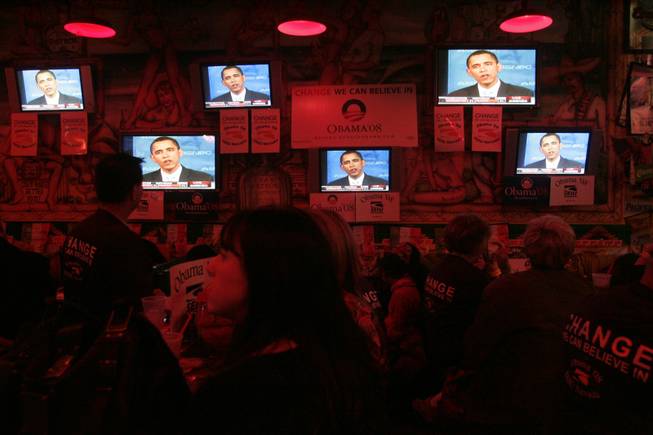
Sam Morris / FILE
Members of the Service Employees International Union join Barack Obama supporters at a rally in Las Vegas in January. SEIU, the nation’s largest labor organization, has pledged a $10 million campaign to press Obama and Congress to pass the Employee Free Choice Act soon after Inauguration Day.
Sunday, Nov. 30, 2008 | 2 a.m.
When Barack Obama stumped in Las Vegas union halls throughout the presidential campaign, he mentioned, almost without fail, his support for an obscure piece of legislation that would make it easier for workers to unionize.
The Illinois senator pledged to sign the bill, dubbed the Employee Free Choice Act, and Big Labor pledged to elect him.
But now, after spending a collective $450 million on election efforts and playing a key role in a number of battleground states, labor leaders may have to wait for their No. 1 priority — the card-check bill. Lawmakers and the incoming Obama administration have signaled that other matters, chiefly the economy and universal health care, will dominate the president-elect’s first 100 days.
Although Obama pledged to sign the bill into law during the campaign, his chief of staff, Rahm Emanuel, in a meeting of chief executives and business leaders this month, declined to say whether the White House would support the legislation.
The reason is clear: The new law could be the most consequential social and economic policy shift since President Reagan reshaped the country by slashing taxes and regulation and crushing unions.
The law would allow workers to form a union by signing cards instead of voting in a secret-ballot election, stiffen penalties for employers who commit unfair labor practices during organizing drives and impose binding arbitration in bargaining cases in which the sides cannot agree. Unions argue that those changes will level a playing field that has tilted toward business at the expense of labor for decades.
The debate would be divisive at a time when Obama has gone to great lengths to bridge the partisan rift in Washington that has grown deeper over the past eight years.
Regardless, pressure is being brought to bear, by both labor and business.
The Service Employees International Union, the country’s largest labor organization, has pledged a
$10 million accountability campaign to urge Obama and Congress to enact the card-check bill in the 100 days after Inauguration Day, Jan. 20.
Anna Burger, the union’s international secretary-treasurer, delivered the message at the SEIU’s convention in June.
“We demand results, and we only get results when we hold politicians’ feet to the fire and remind them that they work for us,” she said. “When it slips their minds, we’re going to run ads against their anti-worker votes. Support the young and long shots over the old guard and the big shots.”
Josh Goldstein, a spokesman for the pro-labor group American Rights at Work, said, “The first opportunity this bill has to be passed, it should be passed.”
The U.S. Chamber of Commerce has its own $10 million campaign to make sure that doesn’t happen.
The chamber deployed a network of operatives in a number of key Senate races this year and campaigned aggressively — on the air and on the ground — against the card-check legislation. It will be maintaining those operations, hoping to win over some senators and peel back others, in addition to running TV ads. Last week it released the first in a series of reports refuting what it calls union rhetoric.
“We are doing our best to point out to the administration that this will be a firestorm on Capitol Hill, bordering on Armageddon,” said Randel Johnson, the chamber’s vice president of labor, at a news conference last week announcing the report.
Johnson said he expects Congress to consider the bill by spring.
Card check’s future could rise or fall in the Senate, where Democrats need 60 votes to overcome a Republican filibuster, which killed the measure when it came before the chamber last year. Democrats will have at least 58 seats come January. (Two races remain undecided.) Chamber officials hope to bring pressure on enough senators to block the bill again, perhaps forcing a compromise.
Indeed, Johnson said the organization would be amenable to smaller, less dramatic changes to existing labor law.
Labor advocates, however, scoffed at that notion.
“We have to solve the problems of sliding wages and increased inequality, and you can’t compromise on solving those problems,” SEIU President Andy Stern told The New York Times this month.
Sun reporter Lisa Mascaro contributed to this story.

Join the Discussion:
Check this out for a full explanation of our conversion to the LiveFyre commenting system and instructions on how to sign up for an account.
Full comments policy