

Hoover Dam to get new turbines, repairs with $52 million in federal funds
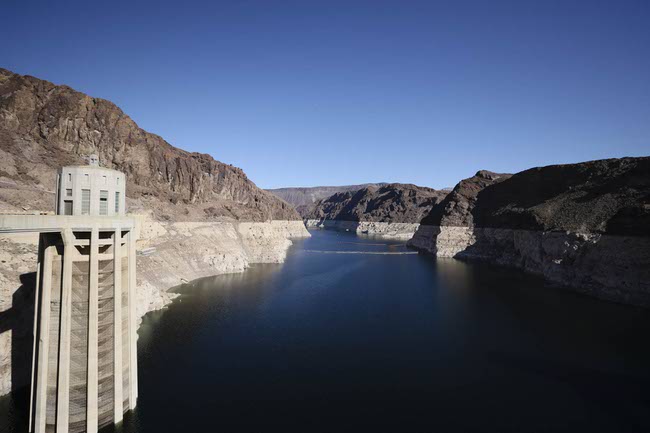
Lake Mead is shown from the Hoover Dam in Boulder City, Tuesday, Feb. 3, 2026. Photo by: Wade Vandervort
Thursday, May 21, 2026 | 9:02 p.m.
Editor's note: Este artículo está traducido al español.
The Bureau of Reclamation is releasing $52 million to fund upgrades and repairs at Hoover Dam, officials announced today.
The money will support operations, maintenance and new turbines engineered to generate hydroelectric power at the lower water levels brought on by prolonged drought in the southwest U.S.
The funds come as officials warn that Lake Mead could drop to historic lows within two years — a prospect that has raised alarm over hydropower supplies for utilities across Arizona, California and Nevada.
“Hoover Dam is one of the most important energy and water infrastructure assets in the American West, and these funds will help ensure it continues delivering reliable, affordable power for Nevada and the Southwest for years to come,” Nevada Gov. Joe Lombardo said in a statement. “As drought conditions and water uncertainty continue to challenge the Colorado River Basin, investing in the long-term reliability and resilience of Hoover Dam is more important than ever.”
The money had been earmarked from post-retirement benefits for workers of the Western Area Power Administration, one of the nation's largest federal utilities. That program was funded elsewhere, but “federal red tape and government inefficiency” led to that money being largely inaccessible for years, U.S. Sen. Catherine Cortez Masto, D-Nev., said.
Cortez Masto in 2024 introduced the Help Hoover Dam Act calling for the release of the funds. Companion legislation was introduced by U.S. Rep. Susie Lee, D-Nev., in the House. It was signed into law earlier this year.
“For decades, millions of federal dollars have been sitting unused while the Hoover Dam is in need of upgrades and repairs,” Cortez Masto said in a statement. “My new law has solved that bureaucratic dead-end. Now we can put those dollars to work improving the Hoover Dam, protecting the water and energy supply for over a million Americans.”
The Bureau of Reclamation testified in support of the legislation, estimating that over $200 million would be needed for routine operation and maintenance of the dam by 2035 when it turns 100.
The Colorado River provides water for around 40 million people, and 1.3 million people get electricity through hydropower produced at Hoover Dam.
In April, the Bureau of Reclamation moved to reduce flows out of Lake Powell in an attempt to protect water levels as the Colorado River faces its worst runoff season on record.
Long-term drought has reduced Colorado River system storage to about 36% of capacity, with conditions intensified by the lowest snowpack on record and record-breaking March heat, the agency said.
Interior Secretary Doug Burgum met with governors from the seven Colorado River Basin states, including Nevada, to discuss hydrology and future operations. The result was to move water from Flaming Gorge Reservoir upstream and reduce releases from Lake Powell, which was forecast to decline below 3,490 feet — the minimum power pool level — by August without intervention.
If Lake Mead’s water elevation falls below 1,035 feet, Hoover Dam’s energy generation capacity is reduced from around 1,302 megawatts to about 382 megawatts, Lombardo said. Hoover Dam's older turbines cannot generate power below that 1,035-foot threshold.
Nevada leaders did not specify all the projects or upgrades the funding would be directed toward but noted some of the money could be used to install turbines needed to create hydroelectric power at lower lake depths.
The wide-head turbines would allow for continued generation at lower reservoir levels, and early estimates put the cost between $8 million and $13 million per turbine.
In December, Lombardo sent a letter to the Department of the Interior urging the agency to “direct your staff to engage promptly and collaboratively with the Hoover hydropower contractors, impacted states, and Congress to identify creative solutions to resolve this issue.”
He stressed that “a clear decision” on the various solutions proposed to allocate support “would allow critical upgrades to move forward without delay so Hoover Dam grid reliability, rural electric affordability, and the broader regional economy remain secure.”